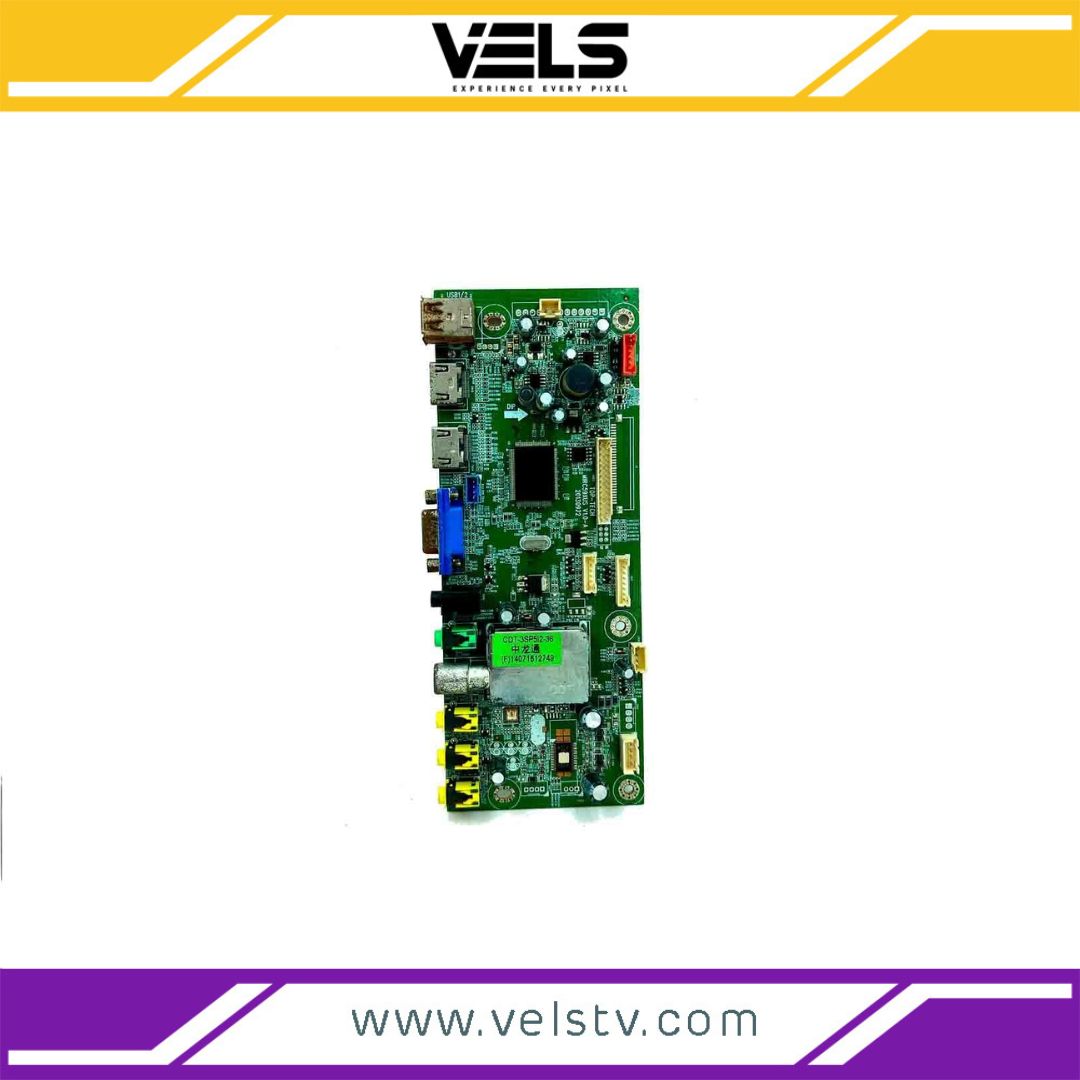
1. Main Processor (CPU)
-
Function: Controls the overall operation of the TV, processes video signals, audio, and manages inputs from various devices.
-
Specs: Typically, this could be an ARM-based or custom processor designed to handle high-definition video, smart TV functions, and input management.
2. Video Processing Unit (GPU)
-
Function: Responsible for rendering video content and scaling it to fit the screen size, enhancing colors, and controlling resolution (HD, Full HD, etc.).
-
Specs: This would handle everything from standard-definition content to higher resolutions like Full HD (1080p) or even support for 4K, depending on the model’s capabilities.
3. Audio Codec/Processor
-
Function: Handles audio processing for both sound quality enhancement and output management. It supports the TV’s speakers, external audio devices, and sound processing.
-
Specs: Likely supports stereo sound or more advanced audio formats (like Dolby Digital or DTS).
4. Memory (RAM and Storage)
-
Function: Temporary memory (RAM) handles processing tasks in real-time. The onboard storage is used for storing the operating system, apps, and settings.
-
Specs: The amount of RAM would typically be in the range of 1GB to 2GB for mid-range TVs, with up to 4GB in more premium models.
5. Input/Output Ports
-
Function: Manages all external connections such as HDMI ports, USB ports, AV inputs, and audio outputs (such as headphone jacks or external speaker outputs).
-
Specs: It might have 2-3 HDMI ports, USB ports for media playback, an Ethernet port for wired internet, and possibly a Wi-Fi module for wireless internet connectivity.
6. Power Supply Circuit
-
Function: Converts AC power from the outlet into the correct DC voltage needed by the motherboard and other components of the TV.
-
Specs: It handles the power regulation to ensure that the TV works without any electrical surges or shortages.
7. Tuner
-
Function: This component receives broadcast signals, allowing the TV to tune into different channels. It could be either a digital (DVB-T2) or analog tuner, depending on the region and model.
-
Specs: A digital TV tuner allows reception of free-to-air TV channels without the need for an external set-top box.
8. Wi-Fi / Bluetooth Module
-
Function: For smart TVs, this module allows the TV to connect to the internet (via Wi-Fi) and potentially pair with external devices (like a Bluetooth speaker).
-
Specs: Most mid-range models will support Wi-Fi standards like 802.11ac and Bluetooth 4.2 or 5.0.
9. OS and Software Interface
-
Function: The operating system allows for navigation through menus, apps, and streaming services. Common smart TV operating systems include Android TV, Linux-based OS, or proprietary systems.
-
Specs: Depending on the model, it might run a basic OS or a fully-fledged smart platform, supporting apps like Netflix, YouTube, etc.
10. Display Interface (LVDS or eDP)
-
Function: Responsible for transmitting the video signal to the TV’s display panel.
-
Specs: Likely uses LVDS (Low-Voltage Differential Signaling) or eDP (Embedded DisplayPort) to ensure fast, high-quality data transmission to the screen.
11. Signal Processing Components
-
Function: Handles processing of different input sources (HDMI, AV, etc.), scaling images, and improving video quality.
-
Specs: Might include a chip for upscaling video to Full HD or 4K, handling various color formats, and improving image sharpness.
12. Buttons and IR Receiver
-
Function: For manual control or remote control functionality. The IR receiver detects signals from the remote.
-
Specs: Basic infrared receiver module that works with the Onida TV remote for navigation and contr
THOMSON (40PATH7777) MOTHERBOARD
Samsung (UA50HU7000R) Motherboard
SAMSUNG (32" UA32FH4003R) MOTHERBOARD
SW97002-CIL LED TV COF IC
SAMSUNG (40"UA40D5000PM) MOTHERBOARD
ONE PLUS (32" HA0AUO) MOTHERBOARD
VU (32 K160M) MOTHERBOARD 


There are no reviews yet.