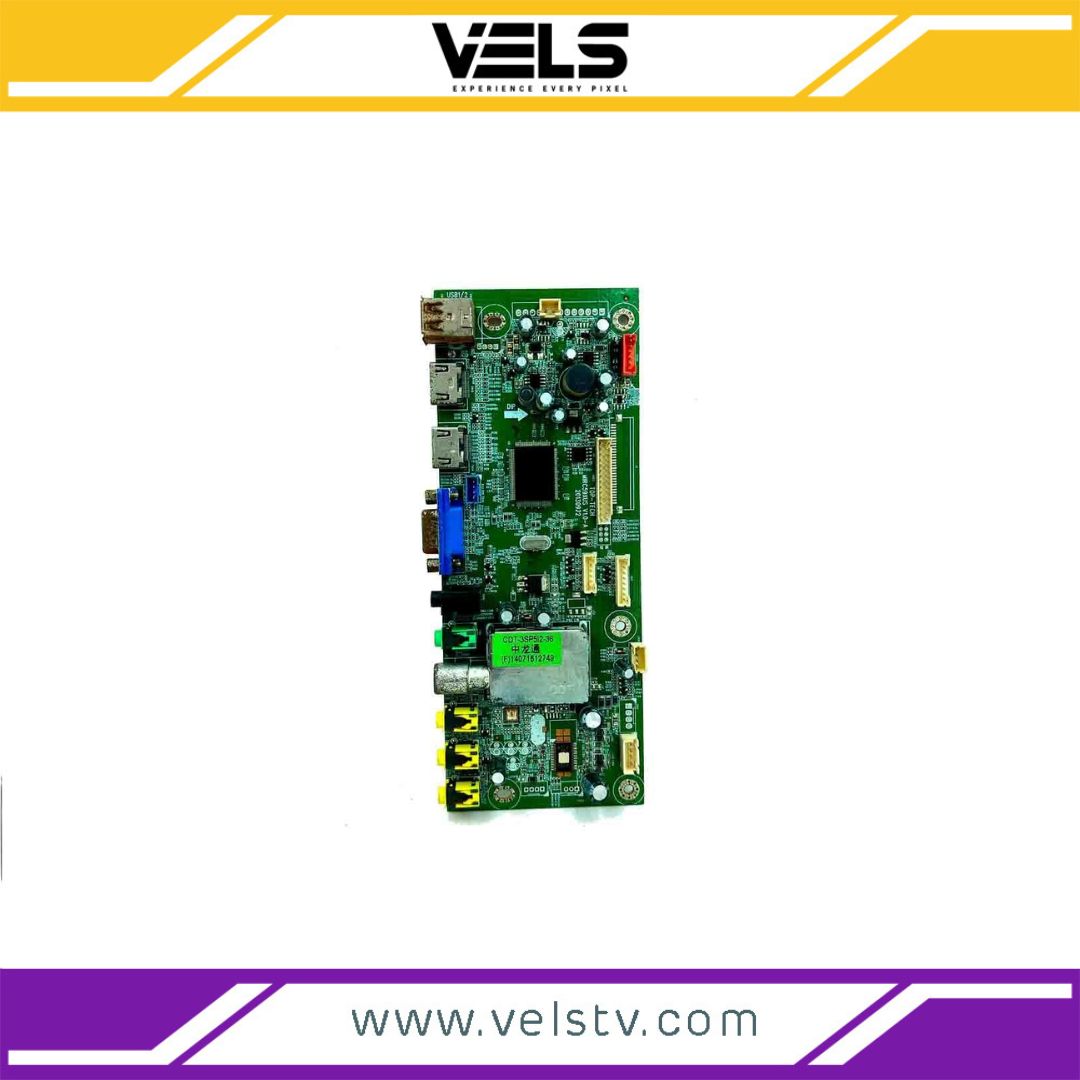
1. Main Processor (CPU)
-
Function: Controls the overall operation of the TV, processes video signals, audio, and manages inputs from various devices.
-
Specs: Typically, this could be an ARM-based or custom processor designed to handle high-definition video, smart TV functions, and input management.
2. Video Processing Unit (GPU)
-
Function: Responsible for rendering video content and scaling it to fit the screen size, enhancing colors, and controlling resolution (HD, Full HD, etc.).
-
Specs: This would handle everything from standard-definition content to higher resolutions like Full HD (1080p) or even support for 4K, depending on the model’s capabilities.
3. Audio Codec/Processor
-
Function: Handles audio processing for both sound quality enhancement and output management. It supports the TV’s speakers, external audio devices, and sound processing.
-
Specs: Likely supports stereo sound or more advanced audio formats (like Dolby Digital or DTS).
4. Memory (RAM and Storage)
-
Function: Temporary memory (RAM) handles processing tasks in real-time. The onboard storage is used for storing the operating system, apps, and settings.
-
Specs: The amount of RAM would typically be in the range of 1GB to 2GB for mid-range TVs, with up to 4GB in more premium models.
5. Input/Output Ports
-
Function: Manages all external connections such as HDMI ports, USB ports, AV inputs, and audio outputs (such as headphone jacks or external speaker outputs).
-
Specs: It might have 2-3 HDMI ports, USB ports for media playback, an Ethernet port for wired internet, and possibly a Wi-Fi module for wireless internet connectivity.
6. Power Supply Circuit
-
Function: Converts AC power from the outlet into the correct DC voltage needed by the motherboard and other components of the TV.
-
Specs: It handles the power regulation to ensure that the TV works without any electrical surges or shortages.
7. Tuner
-
Function: This component receives broadcast signals, allowing the TV to tune into different channels. It could be either a digital (DVB-T2) or analog tuner, depending on the region and model.
-
Specs: A digital TV tuner allows reception of free-to-air TV channels without the need for an external set-top box.
8. Wi-Fi / Bluetooth Module
-
Function: For smart TVs, this module allows the TV to connect to the internet (via Wi-Fi) and potentially pair with external devices (like a Bluetooth speaker).
-
Specs: Most mid-range models will support Wi-Fi standards like 802.11ac and Bluetooth 4.2 or 5.0.
9. OS and Software Interface
-
Function: The operating system allows for navigation through menus, apps, and streaming services. Common smart TV operating systems include Android TV, Linux-based OS, or proprietary systems.
-
Specs: Depending on the model, it might run a basic OS or a fully-fledged smart platform, supporting apps like Netflix, YouTube, etc.
10. Display Interface (LVDS or eDP)
-
Function: Responsible for transmitting the video signal to the TV’s display panel.
-
Specs: Likely uses LVDS (Low-Voltage Differential Signaling) or eDP (Embedded DisplayPort) to ensure fast, high-quality data transmission to the screen.
11. Signal Processing Components
-
Function: Handles processing of different input sources (HDMI, AV, etc.), scaling images, and improving video quality.
-
Specs: Might include a chip for upscaling video to Full HD or 4K, handling various color formats, and improving image sharpness.
12. Buttons and IR Receiver
-
Function: For manual control or remote control functionality. The IR receiver detects signals from the remote.
-
Specs: Basic infrared receiver module that works with the Onida TV remote for navigation and contr
SAMSUNG (32" UA32FH4003R) MOTHERBOARD
VU (32 K160M) MOTHERBOARD
THOMPSON (550ATH0999) MOTHERBOARD
SAMSUNG (UA43NU7100KXXL) MOTHRBOARD
THOMSON (40PATH7777) MOTHERBOARD
MI 55" L55M6EQG MOTHERBOARD 


There are no reviews yet.